
Podcast: Play in new window | Download
The homeschool life is a remarkable opportunity to live life on purpose. You have the chance to customize your child’s education to meet their unique needs and interests while also building a strong family bond and discovering your unique needs and interests. However, it’s easy to get lost in the day-to-day routines and lose sight of the big picture.
That’s where intentional living comes in. By living life on purpose, you can create a homeschool experience that not only benefits your children but also helps you grow as a person.
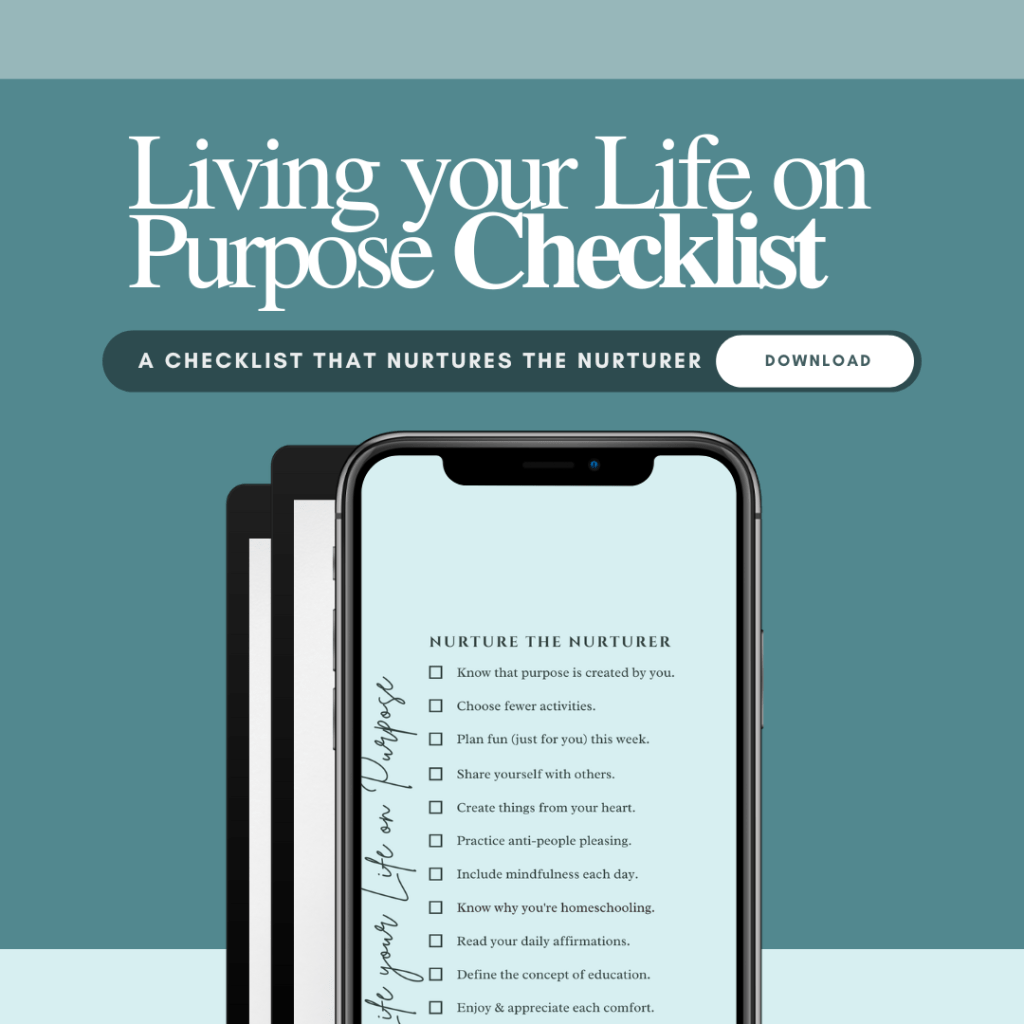
The Power of Intention in your Homeschool Life: Beyond Just Getting Through the Day
Remember that homeschooling isn’t just about academic subjects—it’s about cultivating a life of purpose for your entire family. When you approach each day with intention, even the mundane becomes meaningful.
Step 1: Create a Values-Based Daily Routine
One way to live the homeschool life on purpose as a homeschool parent is to create a daily schedule that reflects your values and priorities.
To live the homeschool life on purpose, your daily or weekly routine can include activities that nourish your mind, body, and soul, as well as time for relationships and personal growth…oh, and learning opportunities too, of course.
Tool: The Values-to-Routine Framework—identify your top 3-5 family values, then ensure your daily activities directly support at least one of these values. If you can’t connect an activity to your values, question whether it belongs in your routine.

Step 2: Identify Your Essential Activities for a Happy Homeschool Life
To start, make a list of activities you would like to include in your day, such as:
- yoga or stretching,
- meditation or prayer,
- morning routine,
- readalouds,
- morning basket time with announcements,
- study time with your kids,
- outdoor time,
- exercise time,
- time to do errands,
- quiet time reading alone (or together as you listen to an audiobook),
- self-coaching and/or self-awareness time, and
- exploratory learning or creative activities for yourself.
Strategy: The Post-it Method—write each activity on a Post-it note, then arrange them on a blank weekly calendar. This visual approach makes it easier to see if you’re overcommitting and helps you create realistic time blocks.
Step 3: Apply the “Does This Serve Us?” Filter
Before adding any activity to your schedule, ask yourself: “Does this serve our family’s values and learning goals?” This simple question can prevent overwhelm and help you focus on what truly matters.
Mindset Shift: Replace “Should we do this?” with “Does this serve us?” This subtle change moves you from obligation-based decisions to purpose-driven choices.
Tool: The Three-Question Filter:
- Does this activity align with our family values?
- Does it meet a genuine need or interest?
- Is the timing right for this activity in our current season?
Step 4: Honor Your Energy Rhythms
Remember, you only have 24 hours in a day, so it’s important to prioritize and make time for rest and transitions.
Consider tracking days when you don’t have the energy for the activities or when you’re feeling overwhelmed.
Those days, such as:
- your period
- premenstrual days
- when your chronic illness overwhelms
- when you have to take someone to a doctor’s appointment
- you’ve got a big life event planned
Strategy: The Energy Calendar—create a personal calendar that tracks your energy levels across the month. Use color-coding to identify high-energy days (green), moderate-energy days (yellow), and low-energy days (red). Plan your homeschool activities accordingly.

Step 5: Develop a Personal Energy Management System
Create a “homeschool energy map” that helps you visualize your natural energy patterns throughout the day, week, and month. Schedule your most demanding activities during high-energy periods and restorative activities during low-energy times.
Strategy: Create a “Quick Recovery” list—when you notice energy flagging, have 5-minute activities ready that help you recharge (deep breathing, stepping outside, drinking water, stretching).
Step 6: Connect your Homeschool Life Activities to Core Values
In your self-coaching time, reflect on what three values reflect yourself, your family, and your goals for life.
In your self-coaching time, reflect on how your chosen activities align with your values, say values of autonomy, independence, building relational connection, and resilience.
Mindset Shift: From “We should do this because other homeschool families do” to “We choose this because it aligns with who we uniquely are as a family.”
Tool: Values Clarity Exercise—have each family member (age-appropriately) identify what matters most to them. Create a family values map where everyone can see how their individual values contribute to the family’s collective direction.

Step 7: Embrace the Growth Mindset
Keep an open mind and be willing to fail, just like you encourage your children to do.
Strategy: The “Beautiful Oops” practice—when something doesn’t go as planned in your homeschool day, model for your children how to turn it into a learning opportunity. Keep a “Beautiful Oops” journal where you document how “mistakes” led to unexpected discoveries.
Mindset Shift: Replace “I’m not good at this” with “I’m learning this.” Apply this not just to academic subjects but to the art of homeschooling itself.
Step 8: Practice Regular Reflection for a Satisfying Homeschool Life
Try out your new routine for a couple of weeks and then evaluate how it’s going. Reflect on what’s working and what needs to be tweaked.
Consider incorporating a journal practice to further develop your self-awareness and personal growth.
Tool: The 15-Minute Weekly Review—set a timer for 15 minutes every Friday to ask:
- What went well this week?
- What was challenging?
- What one thing could we adjust next week?
Strategy: Create a seasonal rhythm of deeper evaluation—at the end of each season (roughly every 3 months), take a half-day to reflect more thoroughly on your homeschool approach and make larger adjustments as needed.

Step 9: Develop a Self-Care Emergency Kit
Create a literal or digital “emergency kit” with quick self-care activities (5-minute meditation scripts, a playlist of uplifting songs, simple stretches) you can turn to when overwhelm strikes.
Strategy: Implement the “Oxygen Mask Principle”—just as airplane safety instructions direct you to put on your own oxygen mask before helping others, create non-negotiable daily practices that ensure your own well-being comes first.
Step 10: Practice the “Three Good Things” Ritual
End each day by identifying three things that went well in your homeschool journey today. This simple gratitude practice can transform how you perceive challenges and celebrate daily victories.
Tool: The Progress Journal—rather than focusing only on what needs improvement, document your family’s learning journey with photos, quotes, and observations that capture growth over time.
Mindset Shift: From “We didn’t do enough today” to “We’re building something meaningful over time.” Homeschooling is a marathon, not a sprint.
Putting this Purposeful Homeschool Life All Together
In conclusion, by living life on purpose as a homeschool parent, you can create a fulfilling and intentional life for yourself and your family.
Remember: A purposeful homeschool life isn’t about perfect planning—it’s about creating space for authentic connection, meaningful learning, and personal growth for everyone in the family, including you.
As Vincent Van Gogh said, “Great things are done by a series of small things brought together.” So start small, be intentional, and watch as your homeschooling journey becomes a beautiful masterpiece.

Rediscover Yourself Beyond Homeschool Mom Guidebook
NURTURING YOU: A Digital Workbook for Homeschool Moms | Instant Download
Rediscover yourself beyond homeschooling with this 14-page guide. Packed with exercises for creativity, self-awareness, and personal growth — perfect for busy moms looking for balance and “me time.”
People also ask:
- Use a Time Audit to Address Unrealistic Homeschool Expectations
- 9 Steps to Thrive: Confident Homeschool Mom in Year 1
- Practical (& useful) steps to boundaries in your homeschool
- The Heart Of Homeschooling: Essential Lessons From Two Experienced Moms
- 7 Ways to Live your Best Life: Self-Care for Homeschool Moms
- The Helpful Homeschool Mom’s Guide To Intentional Living
- Deschooling and Life Purpose: Is there a connection?
- How to homeschool without losing your mind in 11 Steps
- How to Handle Homeschool Overwhelm
- 6 ways to live your homeschool life on purpose
- How can I access life coaching with you?
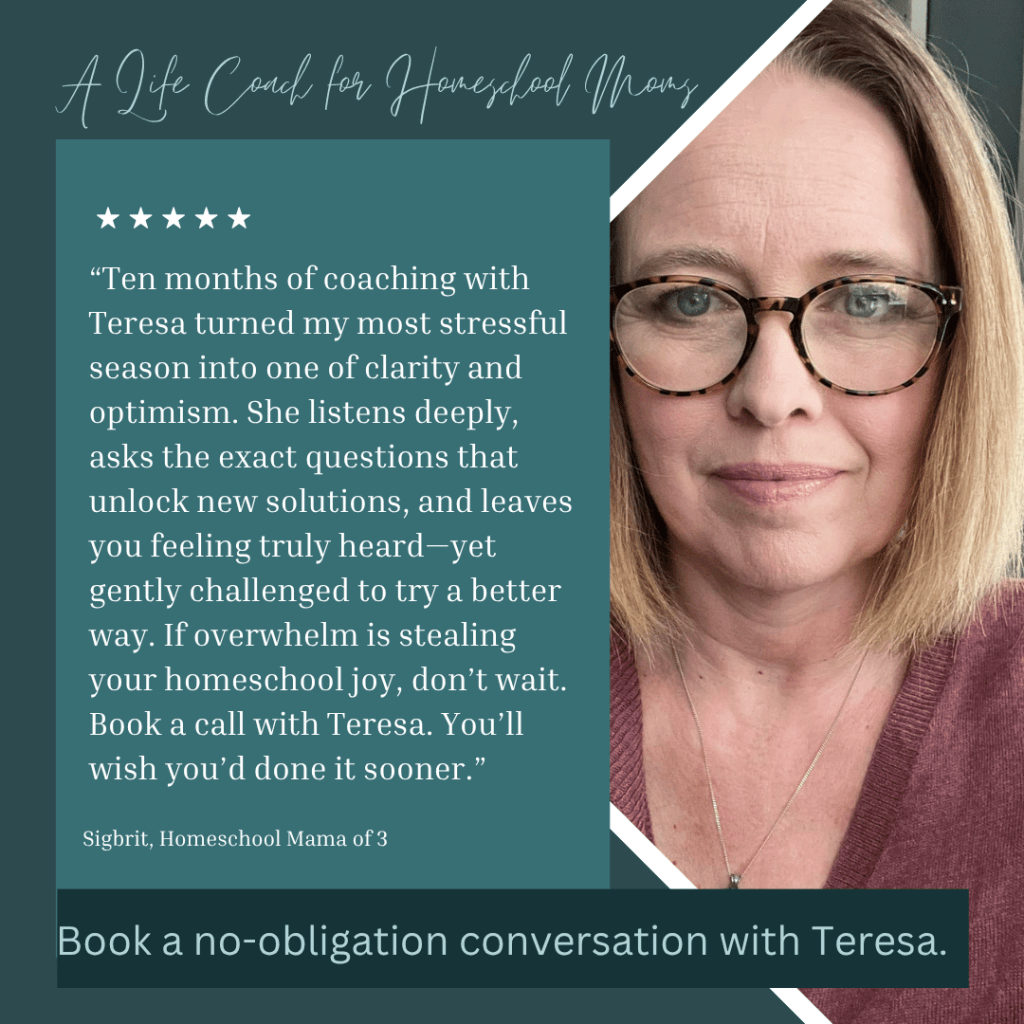
Book your free Aligned Homeschool Reset Session
I help homeschool moms trust themselves, edit expectations, and make intentional choices that create a more confident, connected, and present homeschool life.
Subscribe to the Homeschool Mama Self-Care podcast
Call to Adventure by Kevin MacLeod
Link: https://incompetech.filmmusic.io/song/3470-call-to-adventure
License: http://creativecommons.org/licenses/by/4.0/
